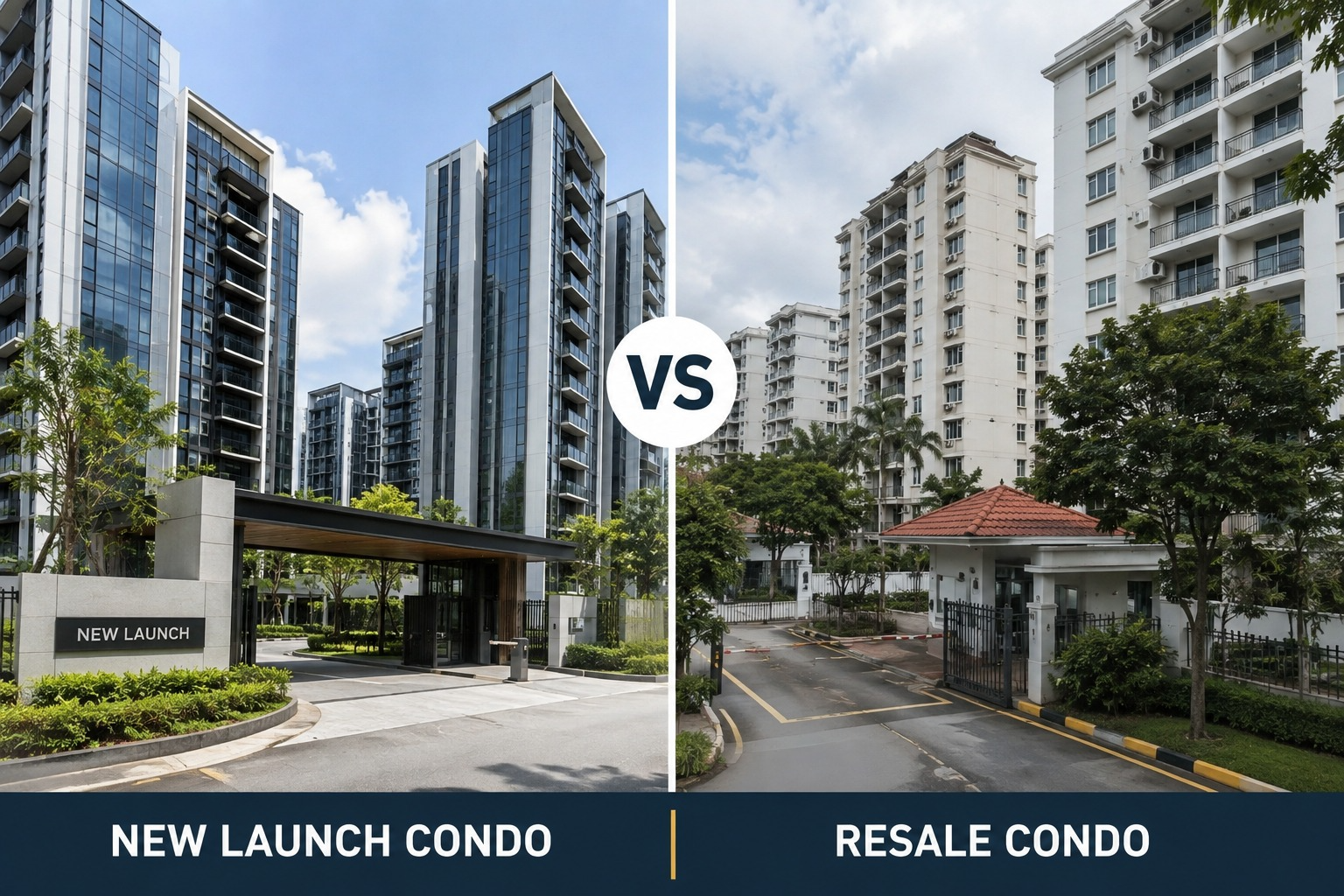
Deciding on a new launch vs resale condo in Singapore used to come down to a simple trade-off: pay more for something brand new, or pay less for something you can move into today. In 2026, it's more complicated than that. A 2024 rule change quietly closed the space-efficiency gap that used to favor resale, and financing conditions have shifted enough that the cash-flow math looks different than it did even two years ago.
This matters whether you're a first-time buyer, an investor comparing rental timelines, or an HDB upgrader weighing your next move. Get this decision wrong, and it's not just about paying more per square foot; it's about locking your cash into the wrong structure for years.
This breakdown comes from Able S.K Toh, an experienced property agent in Singapore who's walked both first-time buyers and seasoned investors through this exact decision, not a generic comparison pulled from a template.
The Short Answer: It Depends on Timeline and Cash Flow
If you need a home now, or want rental income immediately, resale wins. If you can wait 3 to 5 years, want fresh finishes and a longer runway on your lease, and your cash flow benefits from spreading payments out, new launch makes more sense.
Neither option is universally better. The right call depends on your timeline, your budget shape, and what you actually need the property to do for you.
New Launch vs Resale Condo Prices: 2026 PSF Comparison
Real 2026 numbers make the price gap concrete.
| Region | New Launch PSF | Resale PSF |
|---|---|---|
| Core Central Region (CCR) | ~$3,208 | ~$2,215 to $2,800 |
| Rest of Central Region (RCR) | ~$2,695 | Lower, varies by project age |
| Outside Central Region (OCR) | ~$2,154 | Lower, varies by project age |
Across the board, new launches carry roughly a 15-30% PSF premium over comparable resale units in the same area. But PSF alone can mislead you; a newer, more efficient layout can deliver similar usable space to an older, larger-on-paper resale unit, which is exactly the next point worth understanding before you compare purely on price.
Is Resale Really More Spacious? The 2024 Harmonisation Change
For years, resale had a real space-efficiency edge over new launches. Older projects didn't waste floor area on bay windows and planter boxes the way many pre-2024 new launches did; those features counted toward the unit's stated size without adding genuinely usable indoor space.
A URA harmonisation ruling changed how usable floor area gets calculated, effectively closing that gap. New launches built to current guidelines no longer carry the same hidden inefficiency. If you're comparing a new launch vs resale condo in Singapore purely on the old assumption that resale automatically gives you more real space, that assumption is outdated. Check actual usable floor plans for both, not just the headline square footage.
Progressive Payments vs Resale Completion: What Your Cash Flow Looks Like
New launches use the Progressive Payment Scheme: a 5% booking fee at OTP, followed by staged payments tied to construction milestones, each drawing down your bank loan incrementally as the building progresses. Your cash outlay spreads across 3 to 5 years instead of landing all at once.
Resale purchases work differently. You pay the agreed price largely in one transaction at completion, meaning your full down payment and loan drawdown happen upfront, not staged over time.
CPF usage applies to both structures, and mortgage financing works similarly either way. The real difference is timing: progressive payments suit buyers who want smaller near-term cash outlay and steady income to match staged payments, while resale suits buyers who can handle the full financial commitment now in exchange for immediate ownership.
The Rental Income Gap: The Hidden Cost of a New Launch
Here's the part pure PSF comparisons miss entirely. Buy new launch, and you're typically waiting 3 to 5 years for a Temporary Occupation Permit before you can move in or start collecting rent. During that entire window, a resale buyer in a comparable unit is already earning rental income, or already living rent-free in their own home.
That gap is a real opportunity cost, not just a waiting inconvenience. If you're comparing purely on purchase price and PSF, you're missing years of potential rental income that a resale purchase would have already started generating. Investors specifically should run this number before assuming new launch capital appreciation automatically beats resale's earlier cash flow.
ABSD, BSD, Financing, and CPF: Same Rules, Different Timing
The underlying tax and financing rules don't actually change based on new launch versus resale. ABSD follows the same schedule: 0% for citizens on a first property, 20% on a second, 60% flat for foreigners. Buyer's Stamp Duty applies progressively on both. CPF usage and mortgage eligibility work the same way structurally.
What differs is timing, not the rules themselves. Progressive payments mean your ABSD and BSD obligations get triggered against a purchase price that's paid out in stages, while resale triggers the full obligation against a lump-sum transaction. Don't mistake payment timing for a genuine rule difference; the actual tax rates and eligibility criteria are identical.
Who Should Buy New Launch vs Who Should Buy Resale
Buy new launch if:
- You don't need to move in or start renting immediately
- Your cash flow benefits from spreading payments over several years
- You want a fresh 99-year lease and modern layout efficiency
- You're a long-term holder comfortable waiting for capital appreciation
Buy resale if:
- You need to move in now, or start collecting rent immediately
- You want to see the actual unit, view, noise levels, and sunlight before committing
- You have room to negotiate, especially with a motivated seller
- Your lease-decay tolerance is lower, and you want an established, proven location
HDB Upgraders: A Special Case
If you're upgrading from an HDB flat, the calculus shifts again. Selling your HDB and buying a new launch means navigating a gap between your sale proceeds and your progressive payment schedule, plus ABSD exposure if the timing doesn't line up cleanly. Resale often suits upgraders better simply because completion timing is more predictable and easier to sequence against your HDB sale.
That said, resale isn't automatically better for every upgrader; if your HDB sale timeline is flexible and you don't need to move immediately, a new launch's staged payments can actually ease cash-flow pressure during the transition rather than worsen it.
Side-by-Side Decision Table
| Factor | New Launch | Resale |
|---|---|---|
| Purchase price (PSF) | Higher, 15-30% premium | Lower |
| Space efficiency | Improved post-2024 harmonisation | Comparable, no longer a clear edge |
| Move-in timeline | 3-5 years | Immediate |
| Rental income start | Delayed 3-5 years | Immediate |
| Cash flow structure | Staged, progressive payments | Lump sum at completion |
| Negotiation room | Limited, developer-set pricing | Real, especially with motivated sellers |
| Lease freshness | Full fresh tenure | Shorter remaining lease |
| Facilities and finishes | Modern, brand new | Depends on project age |
Why Buyers Work With Able S.K Toh
This decision genuinely depends on your specific numbers, not a universal answer. Able is a PropNex Gold Achiever working across HDB, condo, landed, residential, and commercial property in Singapore, and helps buyers run the real comparison, cash flow, rental timing, and ABSD exposure against their actual situation.
If you're weighing new launch vs resale condo in Singapore for your next purchase, message Able for a straight read on your numbers.
Final Thoughts
There's no universal winner in new launch vs resale condo in Singapore. The right choice ties back to your budget, your timeline, your purpose for the property, and how your cash flow actually works. A long-term holder with flexible timing leans toward a new launch. Someone who needs space or income now leans toward resale.
Visit Able Sell Property or reach out to Able directly to work through which one actually fits your situation.
FAQs
Is it better to buy a new launch or resale condo in Singapore?
It depends on your timeline and cash flow. New launch suits buyers who can wait and want staged payments. Resale suits buyers who need immediate occupancy or rental income.
Are new launch condos more expensive than resale?
Yes, typically 15-30% more per square foot, though the exact gap varies by region and project.
Why are new launch condos more expensive per square foot?
Fresh lease tenure, modern finishes, and developer pricing all contribute, along with the progressive payment structure that spreads cost differently than a resale purchase.
Do resale condos have more usable space?
Not automatically anymore. A 2024 URA harmonisation ruling changed how floor area is calculated, closing much of the space-efficiency gap that used to favor resale.
Is a new launch better for investment?
It depends on your investment goal. A new launch may offer stronger long-term capital appreciation, but resale delivers immediate rental income that a new launch delays for 3-5 years.
How long does a new launch take before I can move in?
Typically 3 to 5 years from purchase to Temporary Occupation Permit, depending on the project.
Is resale better for HDB upgraders?
Often, since completion timing is more predictable and easier to sequence against an HDB sale, though a new launch's staged payments can suit upgraders with flexible timelines.