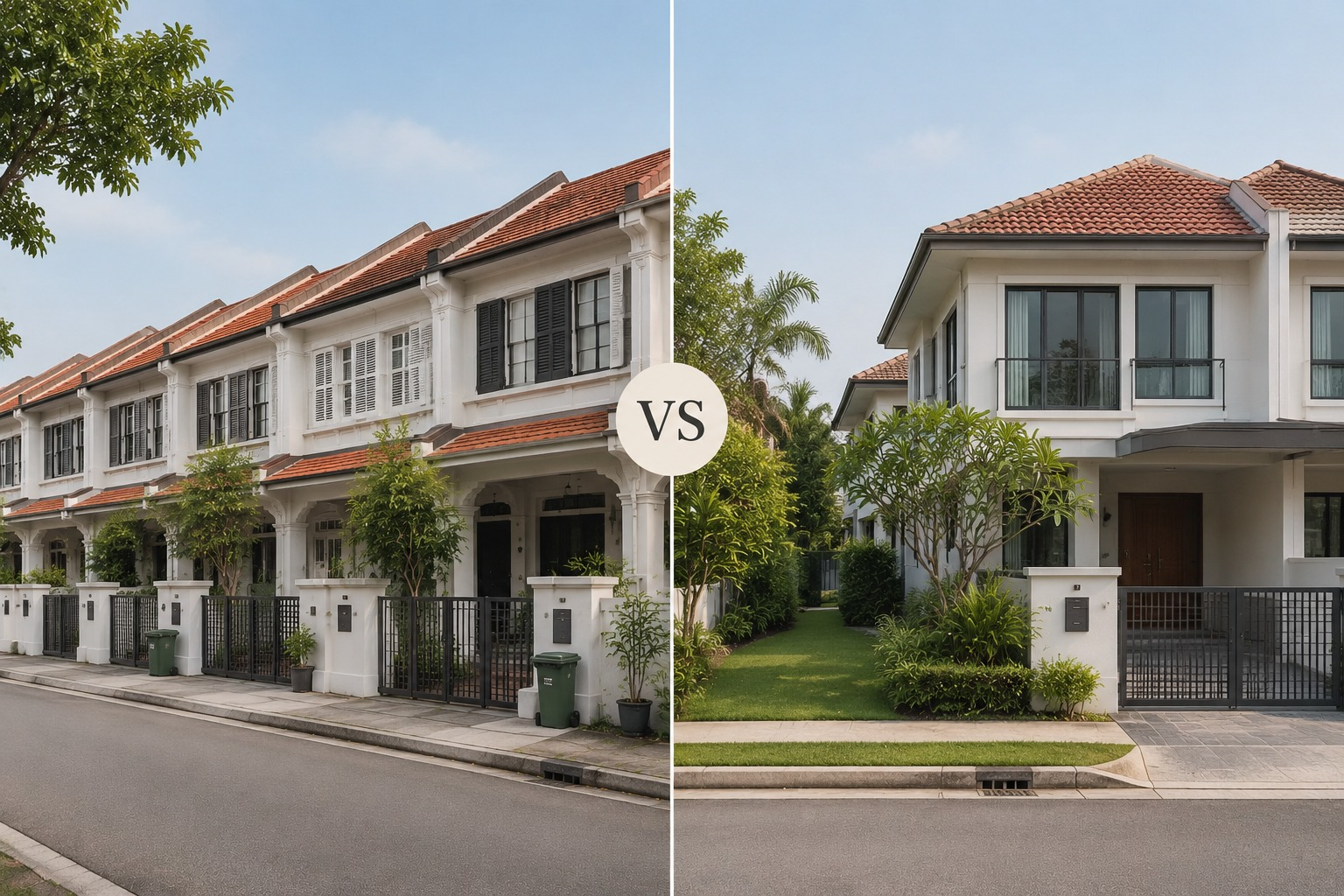
Semi-detached house vs terrace house is the exact fork in the road most Singapore families hit once they're ready to leave condo living behind. Both are landed. Both give you your own plot. But they price differently, appreciate differently, and live differently day to day, and picking the wrong one costs more than just money.
This matters whether you're entering the landed market for the first time or comparing your next move up. Able, the best property agent in Singapore who works landed transactions regularly, walks buyers through exactly this comparison before they commit to either.
Table of Contents
The Core Differences at a Glance
| Feature | Terrace House | Semi-Detached House |
|---|---|---|
| Shared walls | Both sides (intermediate) or one side (corner) | One shared wall only |
| Typical plot size | 1,400-2,200 sqft | 2,200-4,000 sqft |
| Typical entry price (2026) | $2.68M-$3.15M | $3.8M-$5.75M |
| Price premium vs terrace | Baseline | 20-35% more, same precinct |
| Privacy | Lower, especially intermediate units | Higher, one open side |
Corner Terrace vs Semi-Detached: The Confusion Nobody Clears Up
Here's where a lot of buyers get genuinely tripped up. A corner terrace sits at the end of a row, with one side open rather than flanked by neighbours on both sides, which makes it feel similar to a semi-detached house, and some listings market it that way.
It isn't the same thing. A corner terrace is still legally a terrace house, on a terrace-sized plot, and typically prices closer to other terraces in the row than to a true semi-detached. The "one open side" similarity is real, but the land size and title classification aren't. If a listing leans on this comparison to justify a higher asking price, check the actual plot size and URA classification before accepting that framing.
Price Gap: What You're Actually Paying For
In 2026, semi-detached houses typically command a 20-35% premium per square foot over a comparable inter-terrace in the same precinct. That premium tracks land size directly; semi-detached plots run meaningfully larger, and land, not the building itself, drives most of a landed property's value in Singapore's scarce market.
By district tier: entry-level semi-detached houses in fringe districts (16, 17, 18, 26, 27, 28) typically start around $3.8M-$5M. Mid-range districts (13, 15, 19, 20, 21) run $5M-$9M. Prime districts (9, 10, 11) command $8M-$15M and above. Terrace houses in the same districts generally sit 20-35% below their semi-detached counterparts.
The Surprising Appreciation Data Nobody Mentions
Here's the number that should change how you think about this decision, not just the entry price.
Over the past 10 years, terrace houses appreciated by roughly 82.62% in average price per square foot, the strongest growth of any landed category, ahead of even bungalows at 70.37%. Semi-detached houses grew the least of the three, at roughly 61.28%.
That's counterintuitive. The pricier, more spacious option delivered the weakest historical growth. It doesn't mean terrace automatically beats semi-detached as an investment going forward, but it directly challenges the assumption that paying more for more land automatically buys you better appreciation. Run this against your actual holding period and goals before assuming bigger is simply better.
Total Cost of Ownership: Beyond the Purchase Price
Purchase price is only the entry cost. Property tax scales with Annual Value, so a higher-value semi-detached house generally carries a meaningfully larger annual property tax bill than a comparable terrace. Maintenance costs scale with land and building size too; a larger garden, more exterior wall surface, and typically a bigger roof all add up over a multi-year hold.
Rebuild or major renovation costs also differ, which the next section covers in more detail. Factor all of this into your comparison, not just the number on the initial offer.
Space, Privacy, and Daily Living
A terrace house, especially an intermediate unit, means neighbours on both sides and correspondingly more shared noise and less natural light on two walls. A semi-detached house gives you one open side, genuinely more natural light, an actual side garden, and noticeably more privacy for households with young children, elderly parents, or anyone working from home regularly.
That difference is real day-to-day, not just on a floor plan. If privacy and quiet matter more to your household than budget efficiency, this is where semi-detached earns its premium.
Rebuild and Renovation: Party Wall Complexity Compared
An intermediate terrace house has two party walls to consider in any renovation or rebuild, shared boundaries with neighbours on both sides. A corner terrace or a semi-detached house only has one. That single difference genuinely simplifies structural planning, approval coordination, and cost on a semi-detached rebuild compared to an intermediate terrace.
If a significant rebuild is part of your plan rather than just cosmetic renovation, this complexity gap is worth weighing alongside the purchase price difference, not separately from it.
Redevelopment and En-Bloc Potential
Land size also shapes long-term redevelopment potential. A semi-detached house's larger plot generally offers more flexibility for extension or eventual rebuild within URA's plot ratio limits than a smaller terrace plot does. This matters less for collective en-bloc scenarios, which apply mainly to strata developments, but it directly affects what an individual landed owner can do with their own plot over time. If you're weighing this alongside broader market shifts, our guide on Singapore's en bloc threshold changes covers the collective-sale side of redevelopment separately.
When a Terrace House Makes More Sense
- You're entering the landed market for the first time and want to manage budget carefully
- Location matters more to you than plot size; a terrace in a stronger estate beats a semi-detached in a weaker one for most families
- You're planning to rebuild, and want the simpler, cheaper renovation path a corner terrace or well-chosen intermediate unit offers
- Your household doesn't need the extra space a semi-detached provides
When a Semi-Detached House Makes More Sense
- Privacy is a genuine priority, particularly with elderly parents or young children in the household
- You want a side garden and meaningfully more natural light than a terrace offers
- Your budget comfortably absorbs the 20-35% premium without stretching your financing
- An experienced property agent in Singapore can help you weigh whether that premium genuinely fits your household's long-term plan before you commit.
Who Can Buy Either Type
Both terrace and semi-detached houses fall under Singapore's standard restricted residential property rules. Singapore Citizens can generally buy either freely. PRs and foreigners typically need Singapore Land Authority approval before purchasing, and that approval isn't automatic for either type.
Why Buyers Work With Able S.K Toh
Able is a PropNex Gold Achiever and semi-detached property agent in Singapore with real experience across terrace and semi-detached transactions, walking clients through price, appreciation history, and rebuild complexity together, not price alone.
If you're weighing semi-detached house vs terrace house for your own move, message Able on WhatsApp for a straight read on your options.
Final Thoughts
Semi-detached house vs terrace house isn't just a budget question. Price, historical appreciation, renovation complexity, and daily privacy all point in genuinely different directions depending on your household and timeline. The surprising appreciation data alone is worth factoring in before assuming the pricier option is automatically the better long-term move.
Visit Able Sell Property or reach out to Able directly before you commit, especially if a rebuild or long-term hold is part of your plan.
FAQs
What's the main difference between a semi-detached house and a terrace house in Singapore?
A terrace house shares walls with neighbours on one or both sides. A semi-detached house shares only one wall, with an open side garden on the other, on a generally larger plot.
Why are semi-detached houses more expensive than terrace houses?
Primarily land size. Semi-detached plots are larger than terrace plots, and land drives most of a landed property's value in Singapore's scarce market, typically commanding a 20-35% psf premium over a comparable terrace.
Is a corner terrace the same as a semi-detached house?
No. A corner terrace has one open side, similar in feel to a semi-detached, but remains legally classified and typically priced as a terrace house, not a semi-detached.
Which appreciates better, a terraced house or a semi-detached house?
Over the past 10 years, terraced houses appreciated roughly 82.62% versus semi-detached at 61.28%, though future performance depends on specific location and market conditions, not category alone.
Is it cheaper to renovate a terrace house or a semi-detached house?
Generally, a semi-detached house, since it has only one party wall to consider versus an intermediate terrace's two, simplifying structural planning and coordination.
Can foreigners buy a semi-detached or terrace house in Singapore?
Both require Singapore Land Authority approval for PRs and foreigners, which isn't automatic for either type.
Which is better for a family with young children or elderly parents?
Semi-detached houses generally offer more privacy and natural light through the open side, which often suits these households better, provided the budget comfortably supports the premium.